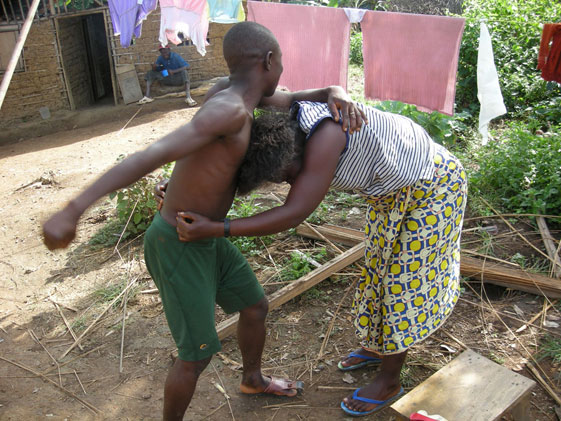
Men feel free to assault women in public, with complete impunity. A Global Crescendo photographer caught this man beating his pregnant wife. The man in the background looking on appears to be laughing.
Women suffer from violence in every society. In few places, however, is the abuse more entrenched, and accepted, than in sub-Saharan Africa. One in three Nigerian women reported having been physically abused by a male partner, according to the latest study, conducted in 1993. The wife of the deputy governor of a northern Nigerian province told reporters last year that her husband beat her incessantly, in part because she watched television movies.

It is like it is a normal thing for women to be treated by their husbands as punching bags," told Obong Rita Akpan, former Nigerian minister for women's affairs, here. "The Nigerian man thinks that a woman is his inferior. Right from childhood, right from infancy, the boy is preferred to the girl. Even when they marry out of love, they still think the woman is below them and they do whatever they want."
In Zambia, nearly half of women surveyed said a male partner had beaten them, according to a 2004 study financed by the United States - the highest percentage of nine developing nations surveyed on three continents. About 80% of Zambian wives find it acceptable to be beaten by their husbands "as a form of chastisement", according to the Zambia Demographic Health Survey.

A World Health Organization study has found that while more than a third of Namibian women reported enduring physical or sexual abuse by a male partner, often resulting in injury, six in seven victims had either kept it to themselves or confided only in a friend or relative.
In South Africa, researchers for the Medical Research Council estimated last year that a male partner kills a girlfriend or spouse every six hours - the highest mortality rate from domestic violence ever reported, they say. In Harare, Zimbabwe's capital, domestic violence accounts for more than 6 in 10 murder cases in court, a United Nations report concluded last year.
Women's rights activists say that the prevalence of abuse is emblematic of the low status of women in sub-Saharan Africa. Typically less educated, they work longer hours and transport three times as much weight as men, hauling firewood, water and sacks of corn on their heads.
Some societies have the idea that women are foolish and childlike, and need to be beaten to be corrected. In one survey, 44.7 percent of Kenyan women said that men have the right to discipline their wives by beating. The women who are beaten often feel that it is their fault. Even many matrilineal and matrilocal societies accept men beating their wives as correction.
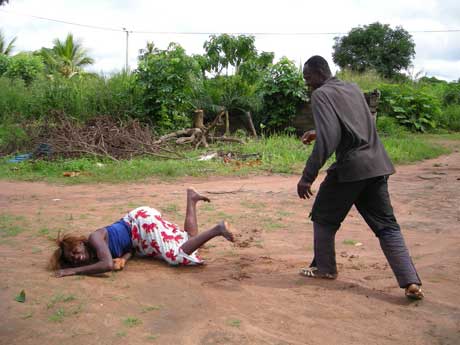
In some Sub-Saharan African countries where wife beating is widely accepted as a response to women's transgressing gender norms, women are More likely than men to justify wife beating. An analysis of Demographic and Health Survey data from in seven Sub-Saharan African countries found that 36-89% of women justified wife beating in at least one of five specified situations such as if she burns the food, neglects the children, argues with him, goes out without telling him or refuses to have sex with. The analysts contend that women's acceptance of wife beating "may be explained only by entrenched social and cultural learning processes that subjugate the position of women in the society, socially and collectively undermine their self-esteem and facilitate romanticisation of the 'ideal' gender role of women."


