Witchcraft Murders: Five people suspected of witchcraft burnt alive in Kenya
Sierra Leone: Women journalists stripped and paraded naked
South African women fall victim to 'corrective rape'
The partially clothed body of Eudy Simelane, former star of South Africa's acclaimed Banyana Banyana national female football squad, was found in a creek in a park in Kwa Thema, on the outskirts of Johannesburg. Simelane had been gang-raped and brutally beaten before being stabbed 25 times in the face, chest and legs. As well as being one of South Africa's best-known female footballers, Simelane was a voracious equality rights campaigner and one of the first women to live openly as a lesbian in Kwa Thema.
Her brutal murder took place last April, and since then a tide of violence against lesbians in South Africa has continued to rise. Human rights campaigners say it is characterised by what they call "corrective rape" committed by men behind the guise of trying to "cure" lesbians of their sexual orientation.
Racism still alive in the "Rainbow Nation": White students force black cleaners to drink urine soup

The alleged victims vomited after being made to eat fouled food
Watch Video
In the video the white students, who make no attempt to hide their faces, order the black cleaners at the whites-only Reitz hostel to down full bottles of beer. They then lead them to a playing field where they are told to display their athletic skills. In the final extract a white man urinates on food and into a plastic soup container. Then, shouting: Take! Take! in Afrikaans he apparently forces the campus employees to eat the dirty food, causing them to vomit.
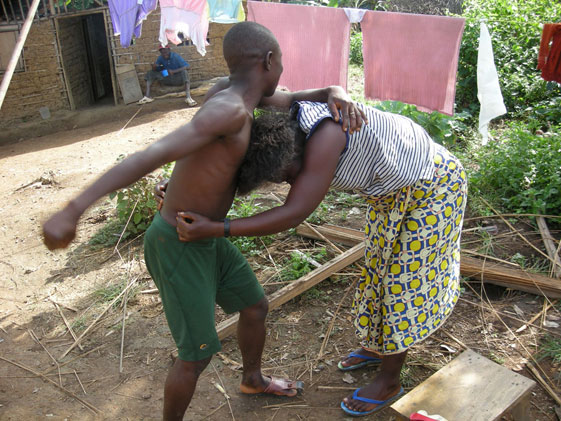
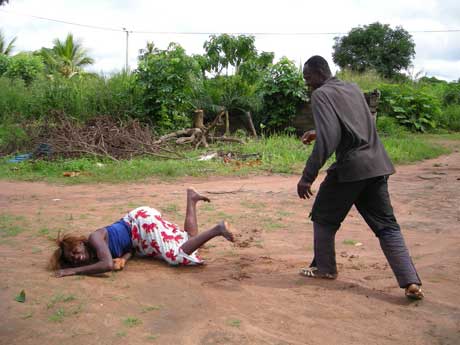
Beaten into silence : Battered women in Africa
Men feel free to assault women in public, with complete impunity. A Global Crescendo photographer caught this man beating his pregnant wife. The man in the background looking on appears to be laughing.
Women suffer from violence in every society. In few places, however, is the abuse more entrenched, and accepted, than in sub-Saharan Africa. One in three Nigerian women reported having been physically abused by a male partner, according to the latest study, conducted in 1993. The wife of the deputy governor of a northern Nigerian province told reporters last year that her husband beat her incessantly, in part because she watched television movies.

It is like it is a normal thing for women to be treated by their husbands as punching bags," told Obong Rita Akpan, former Nigerian minister for women's affairs, here. "The Nigerian man thinks that a woman is his inferior. Right from childhood, right from infancy, the boy is preferred to the girl. Even when they marry out of love, they still think the woman is below them and they do whatever they want."
In Zambia, nearly half of women surveyed said a male partner had beaten them, according to a 2004 study financed by the United States - the highest percentage of nine developing nations surveyed on three continents. About 80% of Zambian wives find it acceptable to be beaten by their husbands "as a form of chastisement", according to the Zambia Demographic Health Survey.
A World Health Organization study has found that while more than a third of Namibian women reported enduring physical or sexual abuse by a male partner, often resulting in injury, six in seven victims had either kept it to themselves or confided only in a friend or relative.
In South Africa, researchers for the Medical Research Council estimated last year that a male partner kills a girlfriend or spouse every six hours - the highest mortality rate from domestic violence ever reported, they say. In Harare, Zimbabwe's capital, domestic violence accounts for more than 6 in 10 murder cases in court, a United Nations report concluded last year.
Women's rights activists say that the prevalence of abuse is emblematic of the low status of women in sub-Saharan Africa. Typically less educated, they work longer hours and transport three times as much weight as men, hauling firewood, water and sacks of corn on their heads.
Some societies have the idea that women are foolish and childlike, and need to be beaten to be corrected. In one survey, 44.7 percent of Kenyan women said that men have the right to discipline their wives by beating. The women who are beaten often feel that it is their fault. Even many matrilineal and matrilocal societies accept men beating their wives as correction.
In some Sub-Saharan African countries where wife beating is widely accepted as a response to women's transgressing gender norms, women are More likely than men to justify wife beating. An analysis of Demographic and Health Survey data from in seven Sub-Saharan African countries found that 36-89% of women justified wife beating in at least one of five specified situations such as if she burns the food, neglects the children, argues with him, goes out without telling him or refuses to have sex with. The analysts contend that women's acceptance of wife beating "may be explained only by entrenched social and cultural learning processes that subjugate the position of women in the society, socially and collectively undermine their self-esteem and facilitate romanticisation of the 'ideal' gender role of women."
Cat woman of Nigeria !!!

Aisha Ibrahim was involved in an auto-accident in Port Harcourt, Nigeria.,but case particularly attracted the media attention because an unusual occurrence was attributed to her. Eyewitnesses said she was hit by a car as a cat, but later transformed into a woman.As the story goes three cats were crossing the busy road when an okada (motorcycle taxi) ran over. One of them immediately turned into a woman. This strange occurrence quickly attracted people around who descended on the scene. A crowd soon gathered, accused her of being a witch and began to beat her up using whatever he came with or could lay his hands on right there. Finally, policemen arrived a the spot and fenced her away from the attackers wanted her dead.
However,another witness gave a completely different account of the incident. He said “I saw the accident as it happened, I saw the car hitting a woman. I didn’t see any cat and it was surprising when everybody said she was a cat and started beating her up instead of helping her.”
Lynchings in Congo as penis theft panic hits capital
This strange event had occurred in Congo.
Police in Congo have arrested 13 suspected sorcerers accused of using black magic to steal or shrink men's penises after a wave of panic and attempted lynchings triggered by the alleged witchcraft.
Rumors of penis theft began circulating last week in Kinshasa, Democratic Republic of Congo's sprawling capital of some 8 million inhabitants. They quickly dominated radio call-in shows, with listeners advised to beware of fellow passengers in communal taxis wearing gold rings.
Some Kinshasa residents accuse a separatist sect from nearby Bas-Congo province of being behind the witchcraft in revenge for a recent government crackdown on its members.
Trokosi: Ritual servitude
Ritual servitude is a practice in Ghana, Togo, and Benin where traditional religious shrines take human beings, usually young virgin girls in payment for services, or in religious atonement for alleged misdeeds of a family member. Tro means deity and kosi means slave or wife so Trokosi translates as slave or wife of the deity.
These shrine slaves serve the priests, elders and owners of a traditional religious shrine without remuneration and without their consent, although the consent of the family or clan may be involved. Those who practice ritual servitude usually feel that the girl is serving the god or gods of the shrine and is married to the gods of the shrine.
These girls are sexually abused, serve at hard labor without compensation, suffer harsh punishment, and are denied education and human affection. If a girl runs away or dies, she must be replaced by another girl from the family. Some girls in ritual servitude are the third or fourth girl in their family suffering for the same crime, sometimes for something as trite as the loss of trivial property. It is still practiced in the Volta region in Ghana, in spite of being outlawed in 1998, and despite carrying a minimum three year prison sentence for conviction. Among the Ewes who practice the ritual in Ghana, the practice is also called trokosi or fiashidi. In Togo and Benin it is called voodoosi or vudusi.
The most disturbing detail is that although the Trokosi system, alongside all traditional and cultural practices that violate the constitution of Ghana was banned in 1998 the practice is still very much alive. In some cases the practice has moved ‘underground’. Some members of the communities involved do not see Trokosi as a Human Rights violation but as a traditional and reliable way of dispensing and maintaining social justice. The researchers estimated the number of victims to be roundabout 1400. To date no one has been arrested or persecuted in spite of the law banning the practice. Tro means deity and kosi means slave or wife so Trokosi translates as slave or wife of the deity.
Breast Ironing: A grim secret of Africa's women
"My mother took a pestle, she warmed it well in the fire and then she used it to pound my breasts while I was lying down. She took the back of a coconut, warmed it in the fire and used it to iron the breasts.I was crying and trembling to escape but there was no way."- Geraldin Sirri, a young student in Cameroon.
What is Breast ironing?

Most tools are warmed before pounding the girls' chests
Is this really what women have to do to protect themselves from sexual assault? Some parents are just doing to so their daughters do not have consensual sex.
"Breast ironing is not a new thing. I am happy I protected my daughter. I could not stand the thought of boys spoiling her with sex before she completed school", one woman explained."Unfortunately, television is encouraging all sorts of sexual immorality in our children."
Prevalence
A pilot study by RENATA (a local NGO composed of teen mothers) suggests that:
*Breast ironing appears to be most widely-practiced in Cameroon. It's more common in the Christian and animist south of the country than the Muslim north, where only 10 per cent of women are affected.
*It also occurs in Guinea-Bissau, West and Central Africa, including Chad, Togo, Benin, Guinea-Conakry.
*Some 24 per cent of girls in Cameroon, about one girl in four, undergo breast ironing.
*Breast ironing occurs extensively in the 10 provinces throughout Cameroon.
*A sample survey published in January 2006 of 5000 girls and women aged between 10 and 82 in Cameroon, estimates that 4 million women had suffered the process.
*Today, 3.8 million teenagers are threatened with the practice.
*Up to 53 per cent of women and girls interviewed in the coastal Littoral province in the southeast, where the country's main port, Douala, is situated, admit to having had their breasts 'ironed'.
*More than half (58 per cent) of cases breast ironing were undertaken by mothers. Other relatives also participate.
Health and Socio-Economic Implications
*Breast ironing is terribly painful and violates a young girl’s physical integrity.
*Breast ironing exposes girls to numerous health problems such as abscesses, itching, discharge of milk, infection, dissymmetry of the breasts, cysts, breast infections, severe fever, tissue damage and even the complete disappearance of one or both breasts.
*This painful form of mutilation could not only have negative health consequences for the girls, but often proves futile when it comes to deterring teenage sexual activity.