Showing posts with label Romani. Show all posts

Working with the Roma People at the Gandhi School, Hungary

In this video below, Cooperative Baptist Fellowship (CBF) Field Personnel Glen and Clista Adkins talk about their involvement with the Gandhi School, Hungary.


The Gandhi High School in Pecs, Hungary, was founded with donations from several Romani organisations in 1992 to be the first Romani high school and has been running since 1994. It was named after the Indian Mahatma Gandhi, to emphasize the Indian origin of all Romani groups. The purpose of the middle school is to provide a school-leaving exam to improve the prospects of Romani children in Hungary and to foster pride in Romani culture. The school is financed by the Hungarian government with additional funds from the EU and donations. The school consists of 6 classrooms where about 250 male and female pupils study, mostly until the ages of 14 to 18. There are also programs for adult education. The first group of pupils who started in 1994 took their school-leaving exam in 2000 and of 18 pupils, 16 have applied to universities and 7 have been taken up. Less than 1% of Roma in Hungary are university graduates. Although the school is open to all, currently only five non-Roma are enrolled.

Romani children used in Nazi racial studies (Video)


Mulfingen, Germany
probably 1943
[Silent, 1:37]

Eva Justin was an assistant to Robert Ritter, the Nazi "expert" on Roma (Gypsies). She studied these Romani (Gypsy) children as part of her dissertation on the racial characteristics of Roma. The children stayed at St. Josefspflege, a Catholic children's home in Mulfingen, Germany. Justin completed her study shortly after this film was taken. After the completion of her studies the 148 children used in the study were deported to the "Gypsy Camp" at Auschwitz on May 9, 1944. Soon after their arrival, Josef Mengele arrived at Auschwitz, some of the children were subjected to his experiments and most where eventually killed in the gas chamber. Justin was indicted and put on trial in 1960 for "deprivation of liberty resulting in death committed by an official of the state" (Freiheitsberaubung im Amt mit Todesfolge). She was not convicted.

Purano manush

The film 'Purano Manush' tells the stories of Roma people in Kosovo who have been displaced during 1999 Balkan war and their longings for a cultural home in ancestral land India.


Hungarian Roma protest against racially motivated murders

A blood stain marks place where a member of Hungary's Roma community was shot and killed.

His was the seventh Roma death in Hungary in a year and the third fatal shooting targeting the Roma community in the past five months.

In March a father and his five year old son were killed as they ran from their home which had been set alight.

The incident mirrored a similar attack on a man and woman in November.

Police are so concerned over the spate of attacks they have offered a 222,000 dollar reward for information.

Meanwhile the Roma community staged a protest in the Hungarian capital Budapest. Speakers criticised the the criminal justice system and people's complacency over the attacks.

Roma people say the marches of the far right radical extremist organization, Magyar Gárda (Hungarian Guard) have legitimized the anti-Roma feelings in society by openly talking about what they call Gypsy crime.

Hungary has one of the largest Roma communities in eastern Europe, which makes up between 5 and 7 percent of the population. They have remained on the margins, lacking jobs, wealth and proper education for decades.

Slovak Police Brutality against Roma kids (Video Included)


The policemen in the eastern city of Kosice, Slovakia forced the six Roma boys aged 11 to 16 to punch each other in the face, kiss each other and strip naked.

The officers also let loose unmuzzled dogs at the boys, and some of the children were bitten.

The policemen recorded “humiliating scenes” with their mobile phones and cameras, laughing and encouraging the children to punch each other.

Referring to the recording, the daily wrote that the police had shouted and called names at the boys and ordered them to undress. The video was released on 8 April, 2009, a day before International Roma Day, a day to raise awareness of anti-Roma discrimination.


The worst case of Slovakian police brutality against the Roma so far occurred in July 2001, when 50-year-old Karol Sendrei was taken to a police station, handcuffed to a radiator and beaten throughout the night. He was discovered dead in the morning with the post-mortem detailing damage to his vital organs from kicks and punches.

The Roma, who make up approximately 6 percent of Slovakia’s population, are targets for abuse in many Eastern and Central European countries where they are a substantial minority.They have long suffered from discrimination in areas such as jobs, education and housing, which has in some places become worse in the current economic crisis.

WATCH VIDEO


A forgotten story : Slavery in Romania

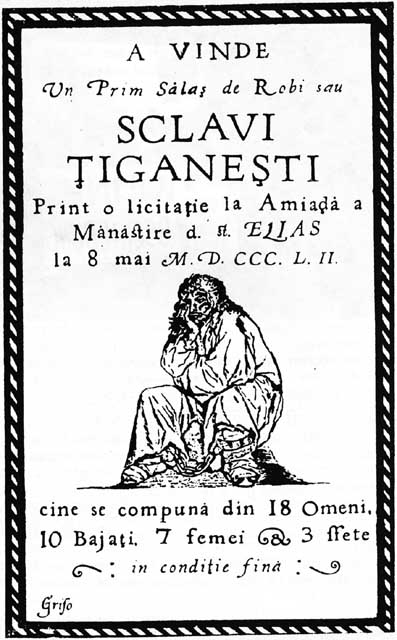
An 1852 poster advertising an auction of Roma slaves in Bucharest, Romania.

Slavery of Roma people (Gypsies) existed on the territory of present-day Romania from before the founding of the principalities of Wallachia and Moldavia in 13th–14th century, until it was abolished in stages during the 1840s and 1850s.

The slaves were considered personal property of the master. They were objects of exchange, sometimes sold by weight; a Rom could be sold for a smaller price than two copper pots, a Roma child could be bought for a smaller price than a cow, because she was not yet good capable of working full-time. Masters offered Roma girls as pleasure toys to their guests; they had the right of life and death over the slave.

The master was allowed to punish his slaves physically, through beatings or imprisonment. 1821, at a time when Boyars in Moldavia fled their country to escape the Eterist expedition, Austrian authorities in Bukovina were alarmed to note that the newly-settled refugees made a habit of beating their slaves in public, and consequently issued an order specifically banning such practices. A dispute followed, after which the Boyars received permission to carry on with the beatings, as long as they exercised them on private property.


A Shatra or Roma(Gypsy) slave village, Romania, 1850s.

Slavery was officially slavery was abolished in 1856. However, Roma people continued to suffer well after the abolition of slavery. They were evicted from their masters’ lands and their huts, with no means of survival, and no resources to carry on with their lives. Many of them went back to their former masters, begging for food and shelter in exchange for hard work. That way, they continued to be half-slaves, servants in the masters’ houses or working on the land, with no access to development resources or to school education.

In a gradual, step-by-step process, Roma began to lose their cultural identity and internalise their inferior status in society. Ashamed of themselves, perceiving their ethnic identity as damnation, they were stigmatised and excluded from the society of their former masters. Roma thus became a scapegoat for all the frustrations and failures of Romanian society.


Sterile Dreams: Forced Sterilization of Romani women in Slovakia and Czech Republic


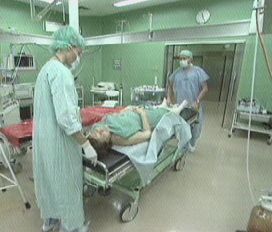
Romani women are being coerced or forced to undergo sterilization procedures in Slovakia’s government-run health facilities, according to a new report released today by the Center for Reproductive Rights and Poradna pre obcianske a ludské práva, in collaboration with Ina Zoon. Two hundred and thirty in-depth interviews were held with Romani women in 40 settlements in eastern Slovakia. The investigative report documents grave human rights violations against Romani women in Slovakia, including about 110 cases where women were forcibly or coercively sterilized, or had strong indications that they had been sterilized. The report also documents extensive racism and verbal and physical abuse towards Romani women in public hospitals, including the denial of patient access to their own medical records and segregation in patients’ rooms, maternity wards, restrooms and dining facilities.


Agata, 28, from Svinia,Slovakia talks about being Coercively Sterilized:
"Doctors came and brought me to the operating room [for a C-section] and there they gave me anesthesia. When I was falling asleep, a nurse came and took my hand in hers and with it she signed something. I do not know what it was. I could not check because I cannot read, I only know how to sign my name. When I left the hospital, I was only told that I would not have any more children…I was so healthy before, but now I have pain all the time. Lots of infections…"

Alexandra from Richnava,Slovakia talks about Racial Segregation in Slovakia’s Public Hospitals:
"In Krompachy hospital, there are separate rooms for Roma—there are three Gypsy rooms, one shower and one toilet for us while white women have their own toilets. White women can go to the dining room but Roma cannot eat there. In Gypsy room, there is not even a dust bin. It is like in a concentration camp there."

Romani women in Slovakia continue to be subject to grave violations of their human rights, particularly their reproductive rights, even though a communist-era law offering monetary incentives for sterilization has been rescinded. A three-month fact-finding in late 2002 by the Center for Reproductive Rights and Poradna pre obcianske a ludské práva (Centre for Civil and Human Rights), a Slovak human rights organization, reveals that not only do coerced and forced sterilization practices continue in Slovakia, so too does the widespread abuse and discrimination against Romani women in the country’s maternal health services. We conducted extensive interviews with more than 230 women in almost 40 Romani settlements throughout eastern Slovakia, the region with the highest concentration of Roma.
The interviews revealed numerous instances of coerced, forced and suspected sterilization of Romani women, along with physical and verbal abuse, racially discriminatory standards of care, misinformation in health matters, and denial of access to medical records.


Iveta Cervenakova, was forcibly sterilized after the birth of her second daughter 12 years ago. She was among possibly as many as a quarter of a million Roma (Gypsy) women sterilized against their will in the Czech Republic.
Since the end of the cold war and the opening up of central and eastern European countries in 1990, the living conditions of the Roma and Sinti minority have drastically deteriorated as a result of nascent racism. However, racist-motivated violence and discrimination against Roma and Sinti have significantly increased in a large number of countries in western Europe. As The New York Times correctly observed in a commentary in March 1996, members of the minority are today subjected to marginalization and racism to an extent that corresponds to the situation of African-Americans in the United States up until the mid-1950s.

A notable cause for the continued marginalization and discrimination of Roma and Sinti is the structures of prejudice and racist clichés, which have been substantially influenced by the misanthropic racial ideology of the National Socialists and the associated fascist regime. In view of these ideological lines of continuity, it is hardly surprising that Roma and Sinti minorities are not only socially disadvantaged to a considerable extent but are also repeatedly the victims of open violence. The authorities in eastern and western Europe have recorded a drastic increase in racist violence against minorities by neo-Nazis; however, such attacks increasingly emanate from the security forces themselves. Only rarely can the perpetrators expect consistent prosecution and conviction by the police and legal authorities. As an example, the police officers responsible for the obviously racist-motivated murders of two Bulgarian Roma in 1996 were not punished by competent authorities; only after a judgement of the European Court of Human Rights in 2005 was the Bulgarian State obliged to investigate the racist background to this crime. The Court issued a similar adjudication in a comparable case, also in Romania; in all probability, however, the perpetrators will escape criminal prosecution appropriate to a State governed by the rule of law.